Capturing Life: A Comprehensive Guide to Working from Photographs (Copy)

As an artist and art tutor, I often emphasise the importance of drawing from life rather than relying solely on photographs. This is primarily because I believe that drawing from life provides artists with a more immersive and authentic experience, that will enable you to better capture the energy, movement, and essence of the subject in a way that would be difficult to replicate by working from photographs alone. As such, I often encourage artists to combine engaging directly with their surroundings, whether its sketching people in public spaces, drawing objects from observation, or capturing scenes from nature, with working from screens or printed photographs, so that they can develop a better understanding of key ideas such as, form, anatomy, and tone.

Beyond the idea of working from life, using photographs a reference for a subject has the potential to improve the process and quality of your drawing skills, making it a convenient and valuable tool for learning opportunities whether you're a beginner or a seasoned artist. As a result, I am entirely cognizant of the many reasons someone may choose to use a photograph as a reference material over drawing from life. For example, photographs offer artists the opportunity to depict a wide range of subjects, from landscapes and still life arrangements to portraits. This could then give you more control over lighting and composition, providing you with the consistency and stability that may be difficult to achieve when drawing from life. Consequently, there has been a noticeable shift in attitudes toward digital reference materials in approaches to art.

Learning Materials
£2.99
Every month


✓ Full access to all of our learning content.
✓ New learning materials added every month.


A guide to tools for observational measuring – Part Two

The joy of life drawing is its directness, when you are in the life room, drawing from the human figure it is just you and the model, and how you draw in response their poses. However, contained in this dynamic is every problem you will face with looking. Life drawing defies preconceived ideas of the human body by challenging you to see the model as they are, rather than how you imagine them to be, in doing so, it creates a stimulating environment where sensation, perception and imagination can grow.

Those with prior experience of figure drawing often note the learning opportunities that are afforded, effectively improving your core drawing skills whilst fostering creativity. However, these same people will often note that when drawing from the human figure your drawing skills are never ‘mastered’, as both you and the model change, meaning the way you see the world today will not be the same as you see it tomorrow. As an art tutor I have found that any artist who has spent time in the life room, will face the same set of problem when drawing from the human figure. This will enviably lead you to spending a lot of time thinking about how you can improve your ability to observe and then draw. For developing your perceptual skills is key to your understanding of form, perspective, proportion and tone. 

To shift to a more robust approach to life drawing, one that will enable you to persist through different drawing challenges, it is important to develop your understanding of proportion and measurement. A Guide to Observational Measuring, Part One, is available from here and outlines different approaches to measuring that will support you to get to grips with measuring proportion. In this blog I will build on this by drawing your attention to different techniques that will train your eye to clearly see proportion, angles, and relationships in the human figure. Although each approach is described separately, they can be intermixed as needed. You may find one of the techniques easier than another, so give them all a try until you settle on the method(s) that work for you and help you to see more objectively.

Learning Materials
£2.99
Every month


✓ Full access to all of our learning content.
✓ New learning materials added every month.

The Figure Drawing – Rapid Sketche

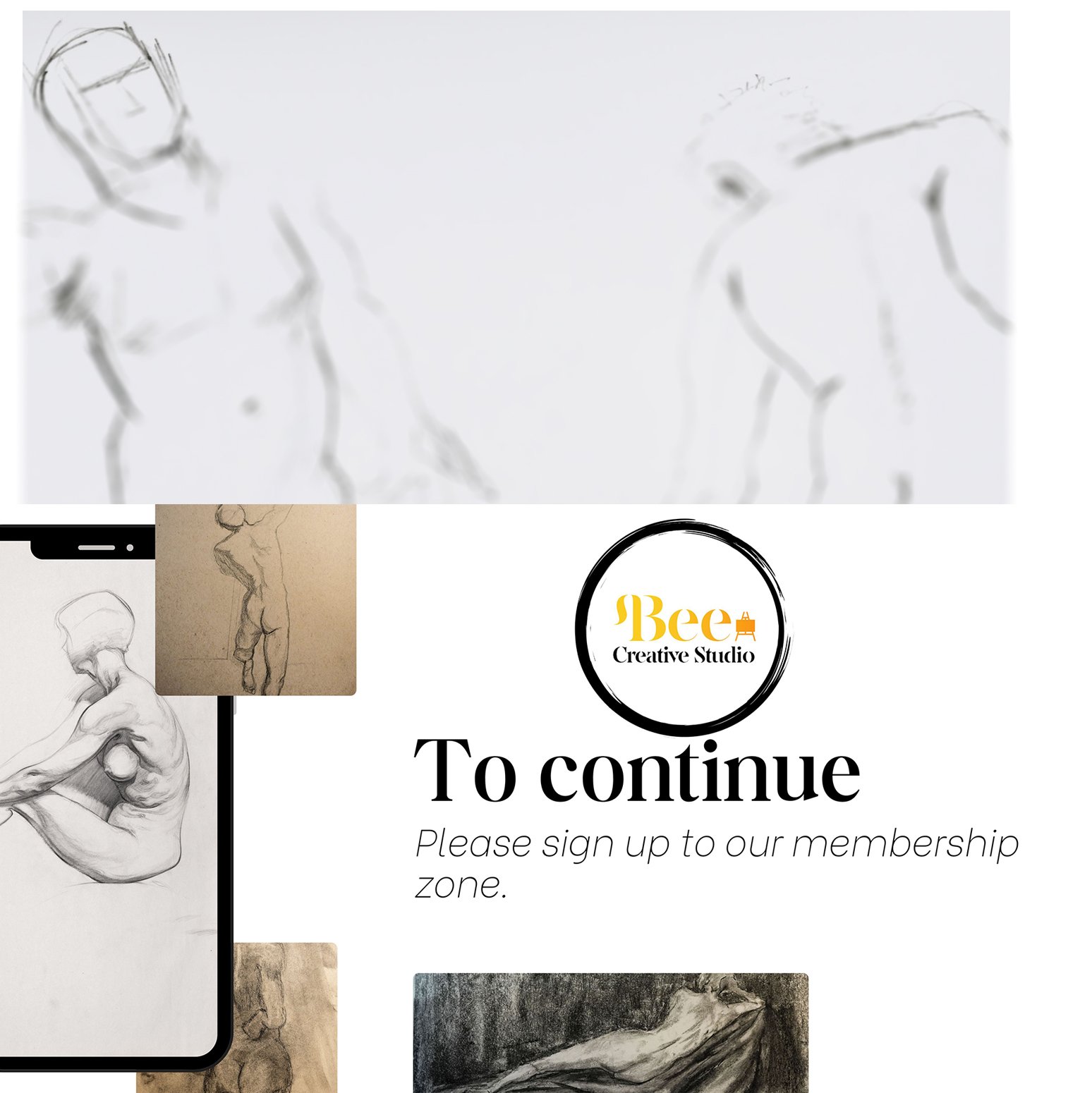
When drawing the figure, you will find that the most spontaneous and immediate drawings you will produce are during the gestural drawing stage, which are normally between 1 and five minutes. This is because rapid sketches encourage the act of capturing the essence of the pose; forcing you to focus on gesture and movement, which will help you to develop a sense of rhythm and flow in your drawings.

What’s more, by working quickly, the short poses will force you to observe and analyse the subject more efficiently so that you can experiment with more spontaneous different ways of capturing and expressing the most important characteristics of the model’s form, posture, and action.

Learning Materials
£2.99
Every month


✓ Full access to all of our learning content.
✓ New learning materials added every month.

Direct Inspiration from Famous Artists for Life Drawing Sessions

Ever since I attended my first life drawing class, the life room has represented both inspiration and challenge to me. Looking around my own life drawing class, I am aware that this communal space provides common ground, where professionals and amateur artists alike can come and practice drawing the human form. The history of drawing and painting the nude is a long one and well within western art tradition. Indeed, from the artwork of the ancient Greeks, where the nude figure is often present in sculptures and on pottery, to the Renaissance paintings, artists have long explored and depicted the human figure.

Today, in a contemporary art world full of photography, video and performance, there has been a resurgence of artists wishing to draw and paint the nude, which in turn has elevated this universal and seminal language beyond its previous station as a training tool, to a legitimate means of artistic expression. With this resurgence in artists wishing to engage in drawing and painting the nude, there is a burgeoning presence of un-tutored life drawing classes across the UK, where likeminded people can engage in lively discussions about figure drawing, explore new media, new technology and develop new ways of thinking.

When attending our life drawing class, you will notice that the human body is a creature of action, capable of delicate and dextrous articulation. For this reason, we have been asking our models to draw direct inspiration from famous artist such as Henry Moore and Zdzisław Beksiński into their poses, as this enables them to exhibit a certain kind of physicality in their poses and supports those attending the class to convey majesty and emotion in their drawings. So, in this blog I am going to explore figure drawing by examining the works of Henry Mooore and Zdzisław Beksiński, with an overview of drawing the figure as a connected whole. The aim is not to teach you how to draw, but to give you a point of inspiration from which to explore the human form.

Henry Moore

Taking inspiration from Henry Moore

In our session on March 15th, Danielle took direct inspiration for her poses from the sculptures of Henry Moore, which are renowned for their organic and abstract forms, that often depict the human figure in a simplified and stylized manner. When looking at Moore’s sculptures one of the most notable characteristics of his work is their emphasis on movement and dynamism. Moore's figures often appear to be in motion, with twisting and contorted forms that convey a sense of energy and vitality. Applying this to the life drawing class, Danielle created poses that conveyed a sense of movement and dynamism, by incorporating twisting and turning movements, as well as asymmetrical postures.

When viewing Moore's sculptures, it becomes obvious that there is an emphasis on the human form as a series of interconnected curved planes, where the figures are often composed of a series of rounded and organic shapes, arranged in a harmonious and balanced manner. When creating life drawing poses inspired by Moore's sculptures, Danielle, paid close attention to the overall composition of the pose, this enabled her to create poses that emphasised the curves and planes of the body, and ensured that the various elements of the pose were arranged in a balanced and harmonious way.

Sculptures by Henry Moore

In addition to the emphasis on movement and composition, Moore's sculptures are also notable for their use of negative space, creating a sense of depth and dimensionality to his artwork.

When creating life drawing poses inspired by Moore's sculptures, Danielle paid attention to the negative space surrounding her body, this ensured she was able to create poses that were interesting and dynamic. By focusing on the elements of movement, composition, negative space, and simplification, Danielle’s poses united the skills of observation, expression and understanding in one coherent approach. This in turn supported the artists to create dynamic and expressive drawings that captured the essence of the human figure.

Zdzisław Beksiński

Taking inspiration from Zdzisław Beksiński

Continuing with the theme of taking direct inspiration from known artists, our session on March 29th saw our model, Simon, channel the work of Zdzisław Beksiński in his poses. In recent years there has been increased interest in Beksiński’s work, this is because his art would often focus on creating surreal and dystopian environments in a unique and highly imaginative style that often featured somber scenes of death and decay, with dramatic depictions of distorted faces and deformed bodies. While it is undeniable that his work includes nightmarish imagery, the artist often stated that his work was not inherently dark, claiming that his paintings didn’t have any meaning, and, instead advised viewers to interpret them however they’d like. However, many art critics and historians have inferred that the frightening subject matter of his work describes his experiences living through The Nazi occupation of Poland, the horrors of the Holocaust and the Soviet invasion of Poland.

Because Beksiński's works are known for their highly detailed and imaginative depictions of human figures, Simon sought to exaggerate and distort his poses, this served as a great source of inspiration for the life drawing artists as it enabled them to capture the essence of the human form whilst pushing the boundaries of traditional life drawing techniques.

Moreover, regardless of Beksiński's denial of intentional meaning behind his work, there are elements of seemingly purposeful use of figurative surrealism, especially in the context of his past that supports the idea of art that seeks to comment on social injustice. By using poses inspired by Beksiński's work in our life drawing class, Simon incorporated storytelling elements into his poses. This allowed the artist to identify strategies for illustrating narratives, and using composition and details to convey a story through images. As a result the artists to push the boundaries of traditional life drawing techniques and experiment with new approaches to capturing the human form so that their life drawing images were more engaging and thought-provoking.

BeeCreative Life Drawing in Manchester City Centre

I really appreciate you reading my words, there's no charge, but if you want to offer a little support, click on the button below to buy me a coffee or two!